
Sunday, August 22, 2010
Intermittent Fasting Blogs
11:51 AM | Posted by
Unknown |
 Edit Post
Edit Post
I've seen lots of new bloggers reporting about their success with the Leangains approach to intermittent fasting, so I thought I'd add them here in case anyone wants to check them out.
Leangains results at SuperBootCampsBlog. Added April 7th.
Bodyrecomposition with Leangains. Added Dec 3rd.
Leangains: Martin Berkhan Means It. Added Dec 3rd.
Martin Berkhan and the Leangains way. Added Dec 3rd.
From fat to fit in 10 weeks with Leangains and paleo. Check out the before/after-pictures.
Cookie Monster tries Leangains and reports fantastic results. Young girl with killer body.
Tucker Redux: 50+ and shredded with the help of Leangains. Direct link to before/after's here.
The Paleo Powerlifter: Leangains before/after pictures and this post for strength results.
Diet Free Dieting: Ben & Jerry's fueled fat loss with the power of Leangains
Firth Fitness: Scorching through stubborn body fat with the Leangains approach
Train Now, Live Later: The Leangains Experiment
This list is far from complete and I'll keep adding blogs here continuously. If you want to join the list, e-mail me at martinberkhan at gmail dot com, or PM me on Facebook or Twitter. Send me the link to the post where you talk about your experiences.
Leangains results at SuperBootCampsBlog. Added April 7th.
Bodyrecomposition with Leangains. Added Dec 3rd.
Leangains: Martin Berkhan Means It. Added Dec 3rd.
Martin Berkhan and the Leangains way. Added Dec 3rd.
From fat to fit in 10 weeks with Leangains and paleo. Check out the before/after-pictures.
Cookie Monster tries Leangains and reports fantastic results. Young girl with killer body.
Tucker Redux: 50+ and shredded with the help of Leangains. Direct link to before/after's here.
The Paleo Powerlifter: Leangains before/after pictures and this post for strength results.
Diet Free Dieting: Ben & Jerry's fueled fat loss with the power of Leangains
Firth Fitness: Scorching through stubborn body fat with the Leangains approach
Train Now, Live Later: The Leangains Experiment
This list is far from complete and I'll keep adding blogs here continuously. If you want to join the list, e-mail me at martinberkhan at gmail dot com, or PM me on Facebook or Twitter. Send me the link to the post where you talk about your experiences.


Tuesday, August 17, 2010
Leangains Pre-Contest Training
2:43 PM | Posted by
Unknown |
Edit Post
Edit Post
Here's a video of Andreaz Engström, current nordic bodybuilding champ and client of mine, preparing for the national championship in Athletic Fitness 2010.
Andreaz does about half of his training fasted. Heavy compound movements predominantely, no pikachu-stuff. He's about 6 weeks out here and strong as ever.
This is a new challenge for Andreaz and the demands are a bit different than bodybuilding. Athletic Fitness is an event where participants are judged for their physique, and their performance in body weight chins and dips, in rowing (the distance covered in 60 seconds), and on an obstacle course (time to finish). Performance is of a greater priority than perfecting the carb load and sodium/water manipulation in the final week. However, I'm confident that he will do very well.

And here's a recent pic about 4 weeks out. As you can see his conditioning is on point.
Andreaz does about half of his training fasted. Heavy compound movements predominantely, no pikachu-stuff. He's about 6 weeks out here and strong as ever.
This is a new challenge for Andreaz and the demands are a bit different than bodybuilding. Athletic Fitness is an event where participants are judged for their physique, and their performance in body weight chins and dips, in rowing (the distance covered in 60 seconds), and on an obstacle course (time to finish). Performance is of a greater priority than perfecting the carb load and sodium/water manipulation in the final week. However, I'm confident that he will do very well.

And here's a recent pic about 4 weeks out. As you can see his conditioning is on point.
Wednesday, August 11, 2010
Leangains Meals Part Two
3:52 PM | Posted by
Unknown |
Edit Post
Edit Post
Time for some more Leangains certified meals from myself, clients and Leangains fans from all around the globe. Click the hyperlinked names after the headings if you want to see the person behind the meals.
Post-workout meal

XXXL roast beef platter with potatoes. This is a meal I've been eating a lot lately. I get the roast beef fresh from the deli since that pre-packaged stuff usually makes me bloated as hell (all pre-packaged and conserved meats are loaded with sodium). Plus fresh roast beef is juicier and tastes a lot better.
500 g roast beef
500 g potatoes fried with 200-300 mushrooms and half an onion.

I roll the roast beef slices up like wraps with the potato mix stuffed in between. Might dip it in some ajvar but I really enjoy the taste au naturale as well.
After that I usually go for one of my berry bowls.

Shown above is 1 kg strawberries with some vanilla protein milk, cacao and sweetener.
I might also go for some protein pudding.

60-90 g chocolate flavored milk protein isolate mixed with 1.5 dl water for each 30 g/1 dl powder. I enjoy this with some full-fat whipping cream. Might put this in the fridge for an hour - makes a decent substitute for ice cream.
Post-workout meal (Robert)
Robert likes oatmeal and pizza post-workout.

100 g oatmeal with 200 g chopped apple, milk, cinnamon and sweetener.

These are made from:
62 g tortilla bread
20 g tomato pure
65 g cheese (5% fat)
50 g ham
30 g shrimps
20 g mushrooms
40 g tomato
Fresh basil and oregano
Comes out to about 392 kcal, 44 g protein, 32 g carbs and 9 g fat per pizza. Pretty damn good macros for a pizza.
Post-workout meals and a rest day meal (David AKA Mr Shreds)

David enjoys chicken, broccoli and potatoes with extras.

And hamburgers with fries.

English breakfast on rest days.
Cheesecake mastery level 2 (Gary)
Gary celebrated the end of his cut with one hell of a cheesecake. This made me painfully aware that I need to sharpen my own cheesecake mastery skills to keep rivals like Gary at bay. I haven't had cheesecake for a good while now, unfortunately.


This beast weighed in at 2.7 kg.

God damn, that looks so good.
Rest day meal (Marjan)
This is what Marjan eats just before hitting the sack.

400 g beef with fried mushrooms
250 g cottage cheese
100-150 g blackberries
Post-workout and a rest day meal (Bob)

An evil insulin-spiking meal is what Bob likes to eat post-workout. No wonder he's fat.
400 g cereal
3 scoops whey protein mixed in blender

3 lbs of gyros meat is another one of Bob's favorites.
Cheeseburger mastery level 4 (Josh)
Josh is well known for his cheeseburger mastery and was kind enough to share some of his secrets with us.

"Start your session by sitting in an upright position and place both hand on the table. This will prepare your body and mind for the task at hand" says Josh.

"There is much debate about the optimal meal drink in cheeseburger mastery circles. The old guard tends to favor milk shakes but coke is quickly gaining popularity among the younger and more liberal masters. Unfortunately, I will not provide details about what I'm drinking here - I'm saving that for the book."

"It is crucial to employ a rest period of 15 seconds every 8th chewing. Beginners typically go at it too fast and risk burnout."
----
Ok, that's all for today. If you have you have a favorite meal you like to eat on your Leangains plan, you can send them over and I might include them in future food posts. Just make sure they follow the general guidelines for rest and training day meals, and ideally include some measurements the way I've done here. I'd appreciate your contribution.
Post-workout meal
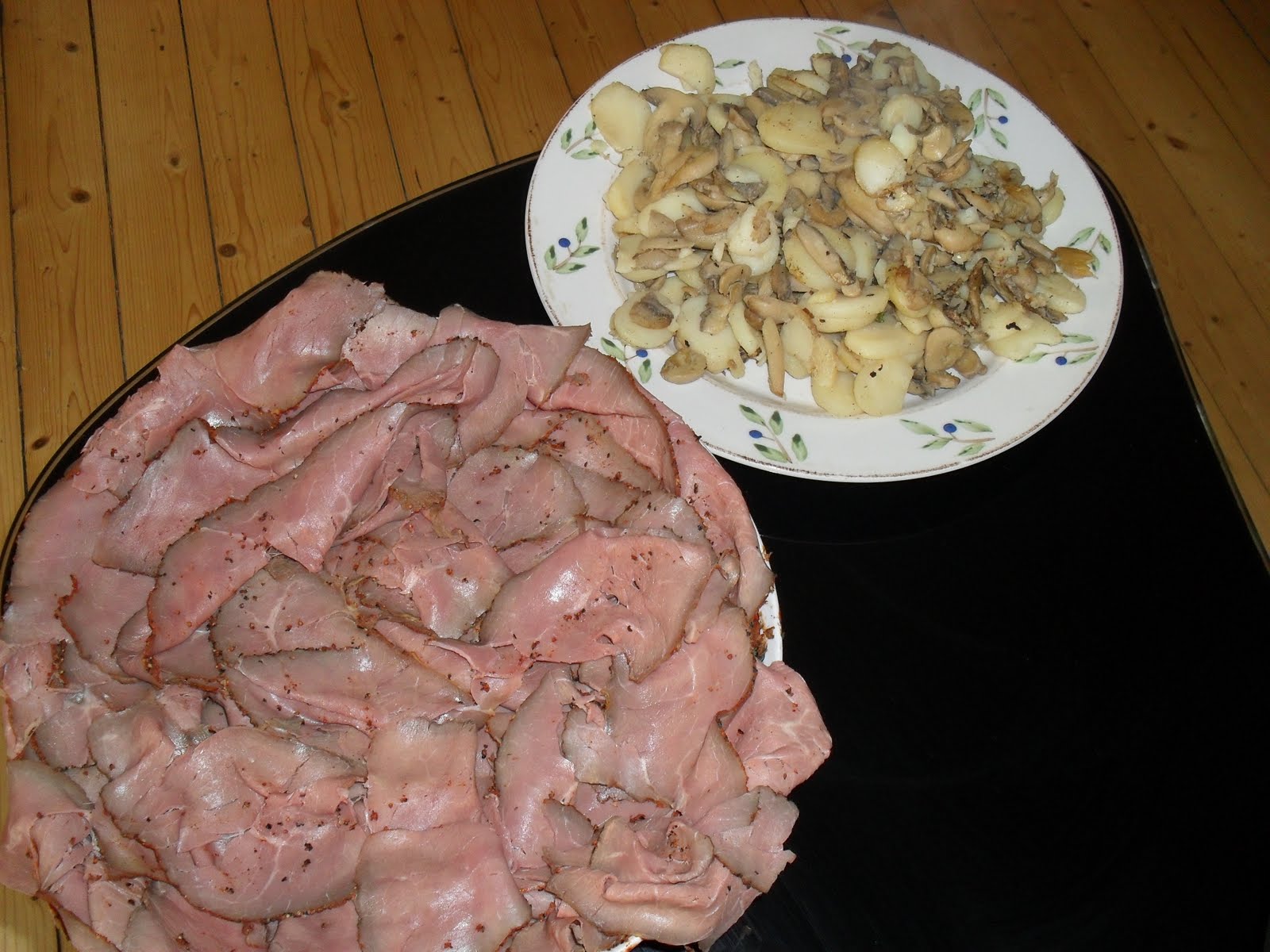
XXXL roast beef platter with potatoes. This is a meal I've been eating a lot lately. I get the roast beef fresh from the deli since that pre-packaged stuff usually makes me bloated as hell (all pre-packaged and conserved meats are loaded with sodium). Plus fresh roast beef is juicier and tastes a lot better.
500 g roast beef
500 g potatoes fried with 200-300 mushrooms and half an onion.

I roll the roast beef slices up like wraps with the potato mix stuffed in between. Might dip it in some ajvar but I really enjoy the taste au naturale as well.
After that I usually go for one of my berry bowls.

Shown above is 1 kg strawberries with some vanilla protein milk, cacao and sweetener.
I might also go for some protein pudding.

60-90 g chocolate flavored milk protein isolate mixed with 1.5 dl water for each 30 g/1 dl powder. I enjoy this with some full-fat whipping cream. Might put this in the fridge for an hour - makes a decent substitute for ice cream.
Post-workout meal (Robert)
Robert likes oatmeal and pizza post-workout.

100 g oatmeal with 200 g chopped apple, milk, cinnamon and sweetener.

These are made from:
62 g tortilla bread
20 g tomato pure
65 g cheese (5% fat)
50 g ham
30 g shrimps
20 g mushrooms
40 g tomato
Fresh basil and oregano
Comes out to about 392 kcal, 44 g protein, 32 g carbs and 9 g fat per pizza. Pretty damn good macros for a pizza.
Post-workout meals and a rest day meal (David AKA Mr Shreds)

David enjoys chicken, broccoli and potatoes with extras.

And hamburgers with fries.

English breakfast on rest days.
Cheesecake mastery level 2 (Gary)
Gary celebrated the end of his cut with one hell of a cheesecake. This made me painfully aware that I need to sharpen my own cheesecake mastery skills to keep rivals like Gary at bay. I haven't had cheesecake for a good while now, unfortunately.


This beast weighed in at 2.7 kg.

God damn, that looks so good.
Rest day meal (Marjan)
This is what Marjan eats just before hitting the sack.

400 g beef with fried mushrooms
250 g cottage cheese
100-150 g blackberries
Post-workout and a rest day meal (Bob)

An evil insulin-spiking meal is what Bob likes to eat post-workout. No wonder he's fat.
400 g cereal
3 scoops whey protein mixed in blender

3 lbs of gyros meat is another one of Bob's favorites.
Cheeseburger mastery level 4 (Josh)
Josh is well known for his cheeseburger mastery and was kind enough to share some of his secrets with us.

"Start your session by sitting in an upright position and place both hand on the table. This will prepare your body and mind for the task at hand" says Josh.

"There is much debate about the optimal meal drink in cheeseburger mastery circles. The old guard tends to favor milk shakes but coke is quickly gaining popularity among the younger and more liberal masters. Unfortunately, I will not provide details about what I'm drinking here - I'm saving that for the book."

"It is crucial to employ a rest period of 15 seconds every 8th chewing. Beginners typically go at it too fast and risk burnout."
----
Ok, that's all for today. If you have you have a favorite meal you like to eat on your Leangains plan, you can send them over and I might include them in future food posts. Just make sure they follow the general guidelines for rest and training day meals, and ideally include some measurements the way I've done here. I'd appreciate your contribution.
Tuesday, August 3, 2010
The Definition of Lean Gains
11:40 AM | Posted by
Unknown |
Edit Post
Edit Post
It's time for another success story. I'm sitting on tons of these. People are getting amazing results following the Leangains guide and I'm stoked to see success stories dropping in by the dozen. This one is pretty damn impressive.
I was quite pleased with my results after an intermittent fasting style "bulk" back in 2006. I gained about 20 lbs of weight in a little more than three months. When I did the math, I came to the conclusion that the ratio of muscle:fat gain was approximately 2:1, meaning 67% of the weight gained was muscle.
What's a standard ratio of fat and muscle gain for the average weight trainer with a non-retarded diet and training routine? Based on the DXA readings I've seen from some folks that have been tracking this, I'd say about 50-60% of the weight gain is typically muscle. With that in mind, I certainly didn't complain. Even though I did gain some fat, I started out very lean and ended up lean - with a lot of extra meat on my bones. Heck, my results after that bulk inspired the name of this site (which is a tad ironic, since most people are using my approach to cut).
However, my results pale in comparison to those of Tanner Maluchnik. Without futher ado, I'll just let him tell you his story.
The definition of lean gains
"Though I personally have not consulted Martin on my IF approach, I have learned everything from him by reading his blog from start to finish including a majority of the comments.
A little over 6 months ago I started eating paleo nutrition style, I was sitting around 170lbs of a short (5'6") and stocky muscle and fat. Due to personal reasons, I stopped working out and eating very clean paleo style. I dropped my weight down to an unhealthily 135lbs in a matter of a couple months. Tons of muscle mass as well as fat dropped off while following the paleo nutrition lifestyle along with my own form of intermittent fasting - as in, I ate whenever I felt like it. Which was like once a day probably only consuming 800-1200 calories at most. I felt excellent from eating the clean paleo foods but I knew this was just not an healthy lifestyle, being sedentary and eating so little. No matter how clean.

Tanner at about 170 lbs back in October. This was before he dropped a ton of weight by undereating.
A little over 3 months ago I decided to get back into my passion. Strength training and nutritrion. Throughout my life since 7th grade I have always been in some form of strength training program for baseball, football and hockey. Then in college I decided to join the cheerleading squad for a large Big 10 University and was in decent shape through all of that. So my base and knowledge of many different routines, styled to quite a few different sports and activities, was there.
However, I decided to pick up a few books, specifically Supertraining , Starting Strength
  , The New Rules of Lifting
 , and also read Martin's entire blog (could not afford his consultation at the time), Alan Aragon's work, and Lyle McDonald's work.
I devised my own strength training program of sticking to the basic compound movement: squats, deadlifts, standing overhead military, bench press, incline press, and bent-over rows. A lot of what I do I learned from Martin as well in the sense that I do not worry about the accessory exercises and focus on compound movements. However I am not currently on a high-intensity approach. I train fasted with 10g of BCAAs beforehand (per Martin's recommendations and research study he provided) and have never felt stronger.
.JPG)
Deciding to pick up strength training again was a wise choice...
I devised my own nutrition program based on what I learned from Martin, Alan, and Lyle. The paleo lifestyle had its merits while I could afford it, but at the moment I find that I am not sensitive to grains, nor carbs, and find my strength and weight climbing up nicely in a high carb/high protein/low-moderate fat routine. I strongly believe the intermittent fasting approach provides wonderful insulin sensitivity with its nutrient partitioning effects.
I came into the intermittent fasting approach from a different perspective than a lot of others on this approach as I wanted to put on as much weight as fast as possible while limiting body fat gain.
While going from 140 lbs to my current weight of 164 lbs in a little over 65 days, there has been no increase in pant sizes and no increase using two different body fat calipers (Jackson-Pollock 3 Point skinfold measure).
I eat tons of "unhealthy" stuff such as sugary cereals (just love em), lots and lots of plain bagels, pasta, lots of protein, and some healthy fats. My post-workout meal is around 2500 calories with around 300g carbs and lots of protein. After that, I eat whenever I am hungry again which is usually within the hour or two.
If you want to see some of the psychological and physical benefits I had on intermittent fasting before my recent mass building phase, I actually did a blog post on intermittent fasting on my blog. Some of the guidelines in that post have changed since I have changed my approach to intermittent fasting a little bit.
I can truly attribute a lot of my progress to what I have learned from Martin at leangains.com and am thinking of setting up a consultation with him whenever I can afford it.

I am now at 164 lbs at a little over 65 days from the first picture. I have never had abs before intermittent fasting but the top 4 are showing through on this lean mass building phase. The abs are solid from top to the bottom from just strictly heavy deadlifts, squats, weightup pushups and chinups. I seem to actually have leaned out a bit as well, which I guess sounds crazy. Over 20 lbs of lean mass AND body fat loss in a little over 60 days possible? The only explanation in my mind is the intermittent fasting approach and my previous base and years of strength training. I am also quite an easy gainer if I incorporate heavy weights."
- Tanner Maluchnik
24 lbs of muscle?
I asked Tanner about his strength stats before and after the weight gain, and here's what he said:
" Squats - My favorite exercise (deep squats)
Before - 135 x 10
Currently - 315 x 6 - Just got out of a new gym today hitting that, when I get to around 6 to 8 reps I will add 10lbs to lifts like squats, deadlifts, bench.
Bench Press - I was struggling on progress here so switched up my workout routine to include two bench sessions a week.
Before - 135 x 10 - was a struggle at first
Currently - 245 x 10
Deadlifts - Second favorite exercise
Before - 135 x 10
After - 335 x 4
Standing Overhead Press - Least favorite exercise
Before - 65 x 6-10
After - 160 x 8
Barbell Bent Over Rows
Before - 85 x 6-10
After - 160 x 10
Chins - Without weights to gauge strength since my own bodyweight was increasing week by week
Before - 8
Now - 27
Pushups
Before - 30
Now - 85 "
---
Needless to say, Tanner had jaw dropping results following the Leangains approach with a few modifications of his own. 24 lbs of muscle, probably more since he looks leaner in the most recent picture, is almost unheard of.
However, it's important to have in mind that Tanner started out fairly emaciated and untrained. With that in mind, he had a lot of room for improvement. The more muscle you have, the slower the gains will be, and vice versa. I've seen similar results (rapid weight gain, most of it muscle) in beginners, and it's not a stretch to put Tanner in that category. Once he upped his calorie intake and started weight training, he blew up. The fact that he had prior weight training experience, from before his undereating phase, certainly might have helped.
Also, a short comment on the paleo diet for muscle gaining. Tanner's experience with the paleo diet should not be interpreted as him being anti-paleo. However, some people have a hard time getting sufficient calories in when adhering to exclusively paleo-based foods. For that reason, they ultimately fail to gain any appreciable amount of muscle mass - especially in combination with intermittent fasting. Personally, I don't have such a problem. I can eat enough meat, veggies and berries to satisfy a small village if I have to.
By the way, for another example of rapid muscle gain, check out Neto's results. He too gained a lot of muscle once he upped his calorie intake after a very long diet stint.
And whenever someone says "ya can't gain muscle with fasting"...just direct them here.
I was quite pleased with my results after an intermittent fasting style "bulk" back in 2006. I gained about 20 lbs of weight in a little more than three months. When I did the math, I came to the conclusion that the ratio of muscle:fat gain was approximately 2:1, meaning 67% of the weight gained was muscle.
What's a standard ratio of fat and muscle gain for the average weight trainer with a non-retarded diet and training routine? Based on the DXA readings I've seen from some folks that have been tracking this, I'd say about 50-60% of the weight gain is typically muscle. With that in mind, I certainly didn't complain. Even though I did gain some fat, I started out very lean and ended up lean - with a lot of extra meat on my bones. Heck, my results after that bulk inspired the name of this site (which is a tad ironic, since most people are using my approach to cut).
However, my results pale in comparison to those of Tanner Maluchnik. Without futher ado, I'll just let him tell you his story.
The definition of lean gains
"Though I personally have not consulted Martin on my IF approach, I have learned everything from him by reading his blog from start to finish including a majority of the comments.
A little over 6 months ago I started eating paleo nutrition style, I was sitting around 170lbs of a short (5'6") and stocky muscle and fat. Due to personal reasons, I stopped working out and eating very clean paleo style. I dropped my weight down to an unhealthily 135lbs in a matter of a couple months. Tons of muscle mass as well as fat dropped off while following the paleo nutrition lifestyle along with my own form of intermittent fasting - as in, I ate whenever I felt like it. Which was like once a day probably only consuming 800-1200 calories at most. I felt excellent from eating the clean paleo foods but I knew this was just not an healthy lifestyle, being sedentary and eating so little. No matter how clean.

Tanner at about 170 lbs back in October. This was before he dropped a ton of weight by undereating.
A little over 3 months ago I decided to get back into my passion. Strength training and nutritrion. Throughout my life since 7th grade I have always been in some form of strength training program for baseball, football and hockey. Then in college I decided to join the cheerleading squad for a large Big 10 University and was in decent shape through all of that. So my base and knowledge of many different routines, styled to quite a few different sports and activities, was there.
However, I decided to pick up a few books, specifically Supertraining
, Starting Strength , The New Rules of Lifting, and also read Martin's entire blog (could not afford his consultation at the time), Alan Aragon's work, and Lyle McDonald's work.I devised my own strength training program of sticking to the basic compound movement: squats, deadlifts, standing overhead military, bench press, incline press, and bent-over rows. A lot of what I do I learned from Martin as well in the sense that I do not worry about the accessory exercises and focus on compound movements. However I am not currently on a high-intensity approach. I train fasted with 10g of BCAAs beforehand (per Martin's recommendations and research study he provided) and have never felt stronger.
.JPG)
Deciding to pick up strength training again was a wise choice...
I devised my own nutrition program based on what I learned from Martin, Alan, and Lyle. The paleo lifestyle had its merits while I could afford it, but at the moment I find that I am not sensitive to grains, nor carbs, and find my strength and weight climbing up nicely in a high carb/high protein/low-moderate fat routine. I strongly believe the intermittent fasting approach provides wonderful insulin sensitivity with its nutrient partitioning effects.
I came into the intermittent fasting approach from a different perspective than a lot of others on this approach as I wanted to put on as much weight as fast as possible while limiting body fat gain.
While going from 140 lbs to my current weight of 164 lbs in a little over 65 days, there has been no increase in pant sizes and no increase using two different body fat calipers (Jackson-Pollock 3 Point skinfold measure).
I eat tons of "unhealthy" stuff such as sugary cereals (just love em), lots and lots of plain bagels, pasta, lots of protein, and some healthy fats. My post-workout meal is around 2500 calories with around 300g carbs and lots of protein. After that, I eat whenever I am hungry again which is usually within the hour or two.
If you want to see some of the psychological and physical benefits I had on intermittent fasting before my recent mass building phase, I actually did a blog post on intermittent fasting on my blog. Some of the guidelines in that post have changed since I have changed my approach to intermittent fasting a little bit.
I can truly attribute a lot of my progress to what I have learned from Martin at leangains.com and am thinking of setting up a consultation with him whenever I can afford it.

I am now at 164 lbs at a little over 65 days from the first picture. I have never had abs before intermittent fasting but the top 4 are showing through on this lean mass building phase. The abs are solid from top to the bottom from just strictly heavy deadlifts, squats, weightup pushups and chinups. I seem to actually have leaned out a bit as well, which I guess sounds crazy. Over 20 lbs of lean mass AND body fat loss in a little over 60 days possible? The only explanation in my mind is the intermittent fasting approach and my previous base and years of strength training. I am also quite an easy gainer if I incorporate heavy weights."
- Tanner Maluchnik
24 lbs of muscle?
I asked Tanner about his strength stats before and after the weight gain, and here's what he said:
" Squats - My favorite exercise (deep squats)
Before - 135 x 10
Currently - 315 x 6 - Just got out of a new gym today hitting that, when I get to around 6 to 8 reps I will add 10lbs to lifts like squats, deadlifts, bench.
Bench Press - I was struggling on progress here so switched up my workout routine to include two bench sessions a week.
Before - 135 x 10 - was a struggle at first
Currently - 245 x 10
Deadlifts - Second favorite exercise
Before - 135 x 10
After - 335 x 4
Standing Overhead Press - Least favorite exercise
Before - 65 x 6-10
After - 160 x 8
Barbell Bent Over Rows
Before - 85 x 6-10
After - 160 x 10
Chins - Without weights to gauge strength since my own bodyweight was increasing week by week
Before - 8
Now - 27
Pushups
Before - 30
Now - 85 "
---
Needless to say, Tanner had jaw dropping results following the Leangains approach with a few modifications of his own. 24 lbs of muscle, probably more since he looks leaner in the most recent picture, is almost unheard of.
However, it's important to have in mind that Tanner started out fairly emaciated and untrained. With that in mind, he had a lot of room for improvement. The more muscle you have, the slower the gains will be, and vice versa. I've seen similar results (rapid weight gain, most of it muscle) in beginners, and it's not a stretch to put Tanner in that category. Once he upped his calorie intake and started weight training, he blew up. The fact that he had prior weight training experience, from before his undereating phase, certainly might have helped.
Also, a short comment on the paleo diet for muscle gaining. Tanner's experience with the paleo diet should not be interpreted as him being anti-paleo. However, some people have a hard time getting sufficient calories in when adhering to exclusively paleo-based foods. For that reason, they ultimately fail to gain any appreciable amount of muscle mass - especially in combination with intermittent fasting. Personally, I don't have such a problem. I can eat enough meat, veggies and berries to satisfy a small village if I have to.
By the way, for another example of rapid muscle gain, check out Neto's results. He too gained a lot of muscle once he upped his calorie intake after a very long diet stint.
And whenever someone says "ya can't gain muscle with fasting"...just direct them here.
Thursday, July 29, 2010
Do Raspberries Stunt Muscle Growth? And much more
5:04 PM | Posted by
Unknown |
Edit Post
Edit Post
Some highlights from my twitter between January and April, with additional commentary. I tend to tweet about recent scientific findings and other stuff I find interesting.
Do raspberries stunt muscle growth?
Tweet: "I'm a sucker for raspberries and sometimes eat them by the pound as a treat with cinnamon or cacao. Raspberry ketones may have some interesting effects: 'Anti-obese action of raspberry ketone'. But this study makes me think twice, since it appears raspberry ketones have anti-androgenic effects. Nothing conclusive in live human subjects though."
Comment: "Anti-androgenic effects" means that raspberry ketones (RK) block androgenic receptors, which should have negative implications for muscle growth. Since I eat a lot of raspberries, I decided to look into this.
In the discussion of the full text version of the study it was extrapolated, from rodent and cell culture studies, that the anti-androgenic effects of RK translates to an intake of ~10 mg/kg body weight, or 800 mg for the average male. Considering raspberries by themselves contain about 2-3 mg RK per 100 g dry weight, it would take about 30-40 kg/70-90 lbs of raspberries per day to reach those levels.
Suffice to say, there's no need cut down on your raspberry intake. However, where these findings might be relevant is in the context of RK supplements, which provide anywhere between 100 mg and 500 mg (!) of RK per capsule.

Here's a treat I eat on a daily basis. I empty a pound of frozen raspberries in a bowl, sprinkle them with cinnamon and/or cacao and pour vanilla protein on. Great stuff.
The cortisol paradox
Tweet: "I have a brutal cold. Ever wondered why symptoms are always worse in the evening (runny nose, sneezing etc)? It's due to cortisol. Cortisol peaks in the morning, which has an anti-inflammatory effect. As cortisol goes down in the evening, the inflammatory response goes up - your immune system can 'run wild' again = runny nose, sneezing etc."
Comment: Cortisol gets a bad rep, but much points towards acute elevations being beneficial, as the above example shows, and not detrimental. A low morning peak in cortisol is why some people feel sluggish after waking and short term effects of cortisol administration, via dexemathasone, elevates mood, increases leptin and provides performance enhancing effects (glucocorticoids such as prednisone and dexamethasone are on the World Anti Doping Agency's list of banned substances). The key word here is short-term. Chronically elevated cortisol, by stress or medication, is a another story. All the positive effects are basically reversed (mood is depressed, leptin is decreased, etc). When this happens depends on dose, but studies usually show that these sides occur after 3-4 days of cortisol treatment.
No best time to train?
Tweet: "It's fascinating how some of the best workouts get done under the worst conditions. Mindset plays a much larger role than people realize. I had some killer sessions after 20 hr + fasts, semi-drunk/with a scorching hangover or with barely an hour of sleep. Or like today, after having been out of commission for almost a week due to a cold."
Comment: Well, the tweet pretty much says it all. I've had some crappy workouts under "ideal" conditions and some great ones under the worst possible conditions. And vice versa, of course.
Knowledge-based work and overeating
This was originally a comment on Lyle's article. More specifically this part:
"Moving on to the other topic of the paper we get to KBW, again referring to activities such where you’re sedentary but engaged in large amount of mental activity. The paper mentions work, school, even video games and computer ‘chatting’ (you Facebook people know who you are) and other related activities as potential examples of KBW.
And, as you might expect, while similarly sedentary like sleeping, the impact of KBW on appetite and body weight regulation tend to be rather negative. The brain, unlike skeletal muscle, can’t use fat for fuel and studies have shown that intense thinking can screw blood glucose levels; this is relevant as some work shows that falling or lowered blood glucose can stimulate hunger."
Tweet: "The study you quoted on ad lib feeding and KBW, the exercise used in that study was perceived as a stressor by the women (as shown by higher cortisol levels vs the control condition), and that’s a significant confounder. KBW is not the trigger for overeating, stress is. I don’t think this was made clear enough in the article. Is there a link between non-stressful KBW and higher calorie intakes in a similar fashion? I don’t think so. Could chatting and WOW contribute to overeating in a similar fasion? Perhaps if they are perceived as stressful events."
Comment: My point here was that it's impossible to say that it's KBW per se that predisposes towards overeating, but rather the stress caused by it. It's not likely that unstressful and leisurely KBW would have the same effects on glucose metabolism and appetite.
Juicing with aspirin?
Tweet: "NSAIDs such as aspirin and ibuprofen inhibit adaptations to resistance training when taken prior to the workout...but actually helps if taken AFTER the workout...and quite significantly so vs placebo: 'Timing of ibuprofen use and bone mineral density adaptations to exercise training'. Maybe we'll see people juicing up on aspirin soon"
Comment: An undesirable side-effect of NSAIDs (Non Steroidal Anti-Inflammatory Drug) is inhibition of prostanglandin synthesis, which results in impaired bone formation. Increased bone formation is one of the adaptations to weight training. Needless to say, taking NSAIDs in conjunction with weight training is something you'd want to avoid. However, animal studies have previously shown that this effect only occurs when NSAIDs are taken prior to mechanical loading. The aim with this study was to test whether this was true for humans as well.
The participants in this study were split into three groups and studied for nine months, during which they were weight training three times a week.
IBUP/PLAC: Received 400 mg ibuprofen prior to weight training, and placebo after.
PLAC/PLAC: Received placebo prior and after training.
PLAC/IBUP: Received placebo prior to weight training, and 400 mg ibuprofen after.
The results showed that bone density in IBUP/PLAC decreased by 0.2%. Regular weight training was not sufficient to compensate for the negative effects of consistent ibuprofen intake.
PLAC/PLAC showed a small and predictable increase of 0.4% in bone density.
And here's the kicker: PLAC/IBUP showed an increase of 2.1% in bone density. So post-workout ibuprofen intake basically increased bone formation by 500% compared to placebo, which is pretty crazy.
What's the explanation here? The researchers speculate that ibuprofen may protect against, or dampen, the surge in inflammatory cytokines which occur post-workout. Inflammatory cytokines acutely inhibit bone formation, so NSAIDs could theoretically combat this by anti-inflammatory action.
However, another perspective on this, not mentioned in the paper, is that exposure to inflammotory cytokines, and other metabolic by-products such as free radical formation, is necessary for optimal training adaptation.
Regardless of the precise mechanism behind the effects of NSAIDs on bone formation, it's safe to say that if you need to take them, do it post-workout.
Lifting weights for toning is horseshit
Tweet: "NY Times: Lifting light weights for "toning" is horseshit: The Claim: For Better Muscle Tone, Go Lighter and Repeat. That's what I've been saying for years...but it's good to see the mainstream catching on."
Comment: I've never believed that women's training routines should look much different from men's training routines in terms of the general setup. The only thing I change is expanding the repetition interval.
I typically use a double progression model where the load is increased when x reps are performed. So for a male, I might tell them to increase the weight by 2.5% or 5 lbs when 8 reps are performed. This usually translates to 5 lbs in most movements, except deadlifts and squats, since 5 lbs is the bare minimum in terms of plates available.
For women, an increase of 5 lbs usually translates to an increase in 5% load or more, which results in a drop off of more reps. Let me give you an example.
Male, bench press (rep range 6-8, increase at 8 reps)
200 x 8 to 205 x 7 (+2.5%). Loss of 1 rep, assuming strength is unchanged.
Female, bench press (rep range 6-9, increase at 9 reps)
80 x 9 to 85 x 6-7 (+6.2%). Loss of 2-3 rep, assuming strength is unchanged.
I tend to stick to the 6-8 rep range for most - not all - upper body movements. If I would have used the same rep range for women, they'd sometimes hit 5 reps or less when increasing the load, which is why I expand the range. This is particularly important for dumbbell movements. For example, going from 20 lbs dumbbells to 22 lbs dumbbells would equate a 10% increase in load and the loss of 4 reps or more. In such cases, I use a 6-10 rep range.

You can bet my client Jennifer didn't do any pump-and-tone bullshit in her glute-specialization routine.
Vegetarian diets and muscle growth
Tweet: "Vegetarian diets aren't optimal for muscle growth: see my comment in 'Book Review: Muscle Gaining Secrets'.
Comment: This was in response to someone who asked me about data for my claim that vegetarian diets aren't optimal for muscle gains. I brought it up because Ferruggia advocates a vegetarian diet - or so I thought. He actually advocates a vegan diet, which is even worse. Anyway, you can see my response in comments, but the gist of it is this:
Studies have concluded that a protein intake of 2 g/kg body weight is needed to optimize muscle gains. However, these studies are based on non-vegetarian diets. Why is this important? It's not only about total protein intake, it's about the BCAA content of the diet. BCAAs, and particularly leucine, are the amino acids most intimately involved in controlling muscle protein synthesis. BCAA content in relation to total calorie content of different foods:
Whey protein: 25% BCAA
Animal protein: 17-18% BCCA
Egg white protein: 18% BCAA
Soy protein: 15-18% BCAA
Cottage cheese: 10-13% BCAA
Beans and peas: 4-5% BCAA
Nuts: 2% BCAA. Speaking of nuts, they're probably the most overrated food deemed "healthy" by the mainstream. I talked about this in "Scorch through your fat loss plateau".
As you can see, plant protein doesn't rank very high in terms of BCAA content. It's likely that a vegetarian diet containing 2 g/kg protein would have a much lower BCAA content than a 2 g/kg protein non-vegetarian diet. Meaning that, in order to get the same effect, you'd have to eat more total protein to reach the same BCAA content than a non-vegetarian diet. Unless you're planning on consuming tons of soy protein (which might have adverse effects).
Now, for a ovo-lacto vegetarian with a decent base of nutritional knowledge it wouldn't be too hard to get quality protein by adding a lot of cottage cheese, egg protein and even whey protein. The real issue as I see it is mainly with vegans and some vegetarians that don't have a clue about what sources to get quality protein from.
Protein trumps fat for satiety
Tweet: Protein trumps fat for satiety: 'Postprandial ghrelin and PYY responses of male subjects on low carbohydrate meals to varied balancing proportions of proteins and fats'
Comment: Nothing new here, just a firm reminder about why I advocate high-protein diets for maintaining low body fat in the long term. It's not that I believe high protein intakes beyond a certain point leads to improved muscle growth, but rather due to the effects on satiety and metabolism (via TEF). Read more here: "Maintaining low body fat".
P.S. I fixed the "Like"-button below, so now it shows you liked the specific post/article and not just my site.
Do raspberries stunt muscle growth?
Tweet: "I'm a sucker for raspberries and sometimes eat them by the pound as a treat with cinnamon or cacao. Raspberry ketones may have some interesting effects: 'Anti-obese action of raspberry ketone'. But this study makes me think twice, since it appears raspberry ketones have anti-androgenic effects. Nothing conclusive in live human subjects though."
Comment: "Anti-androgenic effects" means that raspberry ketones (RK) block androgenic receptors, which should have negative implications for muscle growth. Since I eat a lot of raspberries, I decided to look into this.
In the discussion of the full text version of the study it was extrapolated, from rodent and cell culture studies, that the anti-androgenic effects of RK translates to an intake of ~10 mg/kg body weight, or 800 mg for the average male. Considering raspberries by themselves contain about 2-3 mg RK per 100 g dry weight, it would take about 30-40 kg/70-90 lbs of raspberries per day to reach those levels.
Suffice to say, there's no need cut down on your raspberry intake. However, where these findings might be relevant is in the context of RK supplements, which provide anywhere between 100 mg and 500 mg (!) of RK per capsule.

Here's a treat I eat on a daily basis. I empty a pound of frozen raspberries in a bowl, sprinkle them with cinnamon and/or cacao and pour vanilla protein on. Great stuff.
The cortisol paradox
Tweet: "I have a brutal cold. Ever wondered why symptoms are always worse in the evening (runny nose, sneezing etc)? It's due to cortisol. Cortisol peaks in the morning, which has an anti-inflammatory effect. As cortisol goes down in the evening, the inflammatory response goes up - your immune system can 'run wild' again = runny nose, sneezing etc."
Comment: Cortisol gets a bad rep, but much points towards acute elevations being beneficial, as the above example shows, and not detrimental. A low morning peak in cortisol is why some people feel sluggish after waking and short term effects of cortisol administration, via dexemathasone, elevates mood, increases leptin and provides performance enhancing effects (glucocorticoids such as prednisone and dexamethasone are on the World Anti Doping Agency's list of banned substances). The key word here is short-term. Chronically elevated cortisol, by stress or medication, is a another story. All the positive effects are basically reversed (mood is depressed, leptin is decreased, etc). When this happens depends on dose, but studies usually show that these sides occur after 3-4 days of cortisol treatment.
No best time to train?
Tweet: "It's fascinating how some of the best workouts get done under the worst conditions. Mindset plays a much larger role than people realize. I had some killer sessions after 20 hr + fasts, semi-drunk/with a scorching hangover or with barely an hour of sleep. Or like today, after having been out of commission for almost a week due to a cold."
Comment: Well, the tweet pretty much says it all. I've had some crappy workouts under "ideal" conditions and some great ones under the worst possible conditions. And vice versa, of course.
Knowledge-based work and overeating
This was originally a comment on Lyle's article. More specifically this part:
"Moving on to the other topic of the paper we get to KBW, again referring to activities such where you’re sedentary but engaged in large amount of mental activity. The paper mentions work, school, even video games and computer ‘chatting’ (you Facebook people know who you are) and other related activities as potential examples of KBW.
And, as you might expect, while similarly sedentary like sleeping, the impact of KBW on appetite and body weight regulation tend to be rather negative. The brain, unlike skeletal muscle, can’t use fat for fuel and studies have shown that intense thinking can screw blood glucose levels; this is relevant as some work shows that falling or lowered blood glucose can stimulate hunger."
Tweet: "The study you quoted on ad lib feeding and KBW, the exercise used in that study was perceived as a stressor by the women (as shown by higher cortisol levels vs the control condition), and that’s a significant confounder. KBW is not the trigger for overeating, stress is. I don’t think this was made clear enough in the article. Is there a link between non-stressful KBW and higher calorie intakes in a similar fashion? I don’t think so. Could chatting and WOW contribute to overeating in a similar fasion? Perhaps if they are perceived as stressful events."
Comment: My point here was that it's impossible to say that it's KBW per se that predisposes towards overeating, but rather the stress caused by it. It's not likely that unstressful and leisurely KBW would have the same effects on glucose metabolism and appetite.
Juicing with aspirin?
Tweet: "NSAIDs such as aspirin and ibuprofen inhibit adaptations to resistance training when taken prior to the workout...but actually helps if taken AFTER the workout...and quite significantly so vs placebo: 'Timing of ibuprofen use and bone mineral density adaptations to exercise training'. Maybe we'll see people juicing up on aspirin soon"
Comment: An undesirable side-effect of NSAIDs (Non Steroidal Anti-Inflammatory Drug) is inhibition of prostanglandin synthesis, which results in impaired bone formation. Increased bone formation is one of the adaptations to weight training. Needless to say, taking NSAIDs in conjunction with weight training is something you'd want to avoid. However, animal studies have previously shown that this effect only occurs when NSAIDs are taken prior to mechanical loading. The aim with this study was to test whether this was true for humans as well.
The participants in this study were split into three groups and studied for nine months, during which they were weight training three times a week.
IBUP/PLAC: Received 400 mg ibuprofen prior to weight training, and placebo after.
PLAC/PLAC: Received placebo prior and after training.
PLAC/IBUP: Received placebo prior to weight training, and 400 mg ibuprofen after.
The results showed that bone density in IBUP/PLAC decreased by 0.2%. Regular weight training was not sufficient to compensate for the negative effects of consistent ibuprofen intake.
PLAC/PLAC showed a small and predictable increase of 0.4% in bone density.
And here's the kicker: PLAC/IBUP showed an increase of 2.1% in bone density. So post-workout ibuprofen intake basically increased bone formation by 500% compared to placebo, which is pretty crazy.
What's the explanation here? The researchers speculate that ibuprofen may protect against, or dampen, the surge in inflammatory cytokines which occur post-workout. Inflammatory cytokines acutely inhibit bone formation, so NSAIDs could theoretically combat this by anti-inflammatory action.
However, another perspective on this, not mentioned in the paper, is that exposure to inflammotory cytokines, and other metabolic by-products such as free radical formation, is necessary for optimal training adaptation.
Regardless of the precise mechanism behind the effects of NSAIDs on bone formation, it's safe to say that if you need to take them, do it post-workout.
Lifting weights for toning is horseshit
Tweet: "NY Times: Lifting light weights for "toning" is horseshit: The Claim: For Better Muscle Tone, Go Lighter and Repeat. That's what I've been saying for years...but it's good to see the mainstream catching on."
Comment: I've never believed that women's training routines should look much different from men's training routines in terms of the general setup. The only thing I change is expanding the repetition interval.
I typically use a double progression model where the load is increased when x reps are performed. So for a male, I might tell them to increase the weight by 2.5% or 5 lbs when 8 reps are performed. This usually translates to 5 lbs in most movements, except deadlifts and squats, since 5 lbs is the bare minimum in terms of plates available.
For women, an increase of 5 lbs usually translates to an increase in 5% load or more, which results in a drop off of more reps. Let me give you an example.
Male, bench press (rep range 6-8, increase at 8 reps)
200 x 8 to 205 x 7 (+2.5%). Loss of 1 rep, assuming strength is unchanged.
Female, bench press (rep range 6-9, increase at 9 reps)
80 x 9 to 85 x 6-7 (+6.2%). Loss of 2-3 rep, assuming strength is unchanged.
I tend to stick to the 6-8 rep range for most - not all - upper body movements. If I would have used the same rep range for women, they'd sometimes hit 5 reps or less when increasing the load, which is why I expand the range. This is particularly important for dumbbell movements. For example, going from 20 lbs dumbbells to 22 lbs dumbbells would equate a 10% increase in load and the loss of 4 reps or more. In such cases, I use a 6-10 rep range.

You can bet my client Jennifer didn't do any pump-and-tone bullshit in her glute-specialization routine.
Vegetarian diets and muscle growth
Tweet: "Vegetarian diets aren't optimal for muscle growth: see my comment in 'Book Review: Muscle Gaining Secrets'.
Comment: This was in response to someone who asked me about data for my claim that vegetarian diets aren't optimal for muscle gains. I brought it up because Ferruggia advocates a vegetarian diet - or so I thought. He actually advocates a vegan diet, which is even worse. Anyway, you can see my response in comments, but the gist of it is this:
Studies have concluded that a protein intake of 2 g/kg body weight is needed to optimize muscle gains. However, these studies are based on non-vegetarian diets. Why is this important? It's not only about total protein intake, it's about the BCAA content of the diet. BCAAs, and particularly leucine, are the amino acids most intimately involved in controlling muscle protein synthesis. BCAA content in relation to total calorie content of different foods:
Whey protein: 25% BCAA
Animal protein: 17-18% BCCA
Egg white protein: 18% BCAA
Soy protein: 15-18% BCAA
Cottage cheese: 10-13% BCAA
Beans and peas: 4-5% BCAA
Nuts: 2% BCAA. Speaking of nuts, they're probably the most overrated food deemed "healthy" by the mainstream. I talked about this in "Scorch through your fat loss plateau".
As you can see, plant protein doesn't rank very high in terms of BCAA content. It's likely that a vegetarian diet containing 2 g/kg protein would have a much lower BCAA content than a 2 g/kg protein non-vegetarian diet. Meaning that, in order to get the same effect, you'd have to eat more total protein to reach the same BCAA content than a non-vegetarian diet. Unless you're planning on consuming tons of soy protein (which might have adverse effects).
Now, for a ovo-lacto vegetarian with a decent base of nutritional knowledge it wouldn't be too hard to get quality protein by adding a lot of cottage cheese, egg protein and even whey protein. The real issue as I see it is mainly with vegans and some vegetarians that don't have a clue about what sources to get quality protein from.
Protein trumps fat for satiety
Tweet: Protein trumps fat for satiety: 'Postprandial ghrelin and PYY responses of male subjects on low carbohydrate meals to varied balancing proportions of proteins and fats'
Comment: Nothing new here, just a firm reminder about why I advocate high-protein diets for maintaining low body fat in the long term. It's not that I believe high protein intakes beyond a certain point leads to improved muscle growth, but rather due to the effects on satiety and metabolism (via TEF). Read more here: "Maintaining low body fat".
P.S. I fixed the "Like"-button below, so now it shows you liked the specific post/article and not just my site.
Saturday, July 17, 2010
The truth about alcohol, fat loss and muscle growth
12:04 PM | Posted by
Unknown |
Edit Post
Edit Post
I've been getting tons of questions relating to alcohol and fat loss lately. Happens every time summer rolls around. Outdoor parties, clubbing, vacations and the whole shebang. Alcohol is a key ingredient. What people want to know is basically how fattening alcohol is, how it affects protein synthesis, how to make it work with their diet, and what drinks to go for at the club.
I think this is very good topic to cover today, since we're right in the middle of summer and all, because most people involved in the fitness and health game tend to miss out on a lot of fun due to avoiding alcohol. I know a lot of peeps who'd rather stay home and manage their diet than go out and have a few drinks. Sad, really, because it's all for the wrong reasons. I don't blame them though. Read the mags or listen to the "experts" and you'll soon be believing that a few drinks will make your muscles fall off, make you impotent, and leave you with a big gut. It's mostly bullshit, of course. No big surprise when we're dealing with the alarmist fitness mainstream that can't seem to put things in the right perspective if their life depended on it.
This is a definitive primer on the effects of alcohol on all things someone interested in optimizing body composition might be interested in. At the end of this article I'm also going to show you how a hopeless drunk like myself can stay lean while drinking on a regular basis.

C'mere and lemme me tell you my secretz...*hick*
Alcohol and thermogenesis
There's been an ongoing debate for years whether alcohol calories "count" or not. This debate has been spurred on by the fact that drinkers weigh less than non-drinkers and studies showing accelerated weight loss when fat and carbs are exchanged for an equivalent amount of calories from alcohol. The connection between a lower body weight and moderate alcohol consumption is particularly strong among women. In men it's either neutral or weak, but it's there.
How can this be explained, considering that alcohol is a close second to dietary fat in terms of energy density per gram? Not to mention the fact that alcohol is consumed via liquids, which doesn't do much for satiety?
Alcohol is labeled as 7.1 calories per gram, but the real value is more along the lines of 5.7 calories due to the thermic effect of food (TEF) which is 20% of the ingested calories. This makes the TEF of alcohol a close second to protein (20-35% depending on amino acid composition). The heightened thermogenesis resulting from alcohol intake is partly mediated by catecholamines.
Is higher TEF a reasonable explanation for lower body fat percentage in regular drinkers? We need to consider that alcohol does not affect satiety like other nutrients. The disinhibition of impulse control that follows intoxication may also encourage overeating. Ever come home from a party in the middle of the night and downed a box of cereals? That's what I mean.
It's unlikely that the effect of alcohol on body weight in the general population can be attributed solely to the high TEF of alcohol. An alternative explanation is that alcohol consumption decreases food intake in the long term.
Another explanation is that regular alcohol consumption affects nutrient partitioning favorably via improvements in insulin sensitivity.
Alcohol, insulin sensitiviy and health
Moderate alcohol consumption improves insulin sensitivity, lowers triglyceride concentrations and improves glycemic control. Not only in healthy folks, but also in type 2 diabetes. There is no clear consensus on the insulin sensitizing mechanism of alcohol, but one viable explanation may be that alcohol promotes leanness by stimulating AMPK in skeletal muscle. It's not a stretch to assume that this might have favorable effects on nutrient partitioning in the longer term.
If the effect of alcohol consumption on insulin sensitivity doesn't impress you, then consider the fact that studies have consistently shown that moderate drinkers live longer than non-drinkers. This can be mainly attributed to a lowered risk of cardiovascular disease. However, alcohol also contributes to a healthier and disease-free life by protecting against Alzheimer's disease, metabolic syndrome, rheumatoid arthritis, the common cold, different types of cancers, depression and many other Western diseases. The list goes on and on.
It can almost be said beyond doubt that moderate alcohol consumption is healthier than complete abstinence. With this in mind, it's strange that the fitness and health community shun alcohol. This irrational attitude seems to be grounded in the beliefs that alcohol is fattening and will hamper muscle gains. So let's take a look at that.
Alcohol, hormones and training
You've probably heard that alcohol intake lowers testosterone. While this is true, the actual impact has been widely exaggerated. A three-week study that had men and women consume 30-40 g alcohol per day, showed a 6.8% reduction in testosterone for the men and none for the women at the end of the study-period. That's three beers a day for three weeks and a measly 6.8% reduction in testosterone for the men. What kind of an effect would you think a few beers on an evening once or twice a week would have? Hardly any.
For alcohol to significantly lower testosterone, you need to do some serious drinking. ~120 g alcohol, the equivalent of 10 beers, will lower testosterone by 23% for up to 16 hours after the drinking binge. If you drink so goddamn much that you are admitted to the hospital, you get a similar effect with a reduction of about -20%.
A few studies have looked at alcohol consumption in the post-workout period. One study examined the hormonal response to post-workout alcohol consumption using 70-80 g alcohol, equivalent to 6-7 beers. Talk about "optimizing" nutrient timing. Anyway, despite this hefty post-workout drinking binge, no effect on testosterone was found and only a very modest effect on cortisol was noted. The latter is as expected, considering the effect of alcohol on catecholamines. Citing directly from this paper, this quote sums up the scientific findings regarding the effects of alcohol on testosterone:
"Although the majority of studies involving humans show no ethanol effect on serum luteinizing hormone (LH), some data have demonstrated an increase while others have supported a decrease"
- Koziris LP, et al (2000).
It seems that the fitness mainstream, which has been most adamant about propagating the "alcohol-zaps-testosterone-myth", have cherry-picked a bunch of studies to base their claims on. Well, no big surprise there. We've been through this many times before with meal frequency and countless other diet myths.
When it comes to recovery after strength training, moderate alcohol consumption (60-90 g alcohol) does not accelerate exercise-induced muscle damage or affect muscle strength.
However, the research is a bit mixed on this topic. One study, which used a very brutal regimen of eccentric training only, followed by alcohol intakes in the 80 g range (1 g/kg) noted impaired recovery in the trained muscles. I should note that eccentric training is hard to recover from and the volume used here was pretty crazy.
Another study looked at exhaustive endurance training followed by post-workout alcohol intakes in the 120 g range (1.5 g/kg) and saw significant suppression of testosterone that carried over to the next day.
The common denominator among these two studies is either extremely tough training or unusually high alcohol intakes in the post-workout period. Unless you're in the habit of going bar-hopping after 50 reps of eccentric leg extensions to failure, this stuff does not apply to you. Yet it's studies like these that gets the attention among the alcohol-alarmist fitness crowd.
What about protein synthesis? Strangely enough, the acute effects of alcohol on muscle protein synthesis in normal human subjects are non-existent in the scientific litterature. It has only been studied in chronic alcoholics, which have reduced rates of muscle protein synthesis. Chronic alcoholic myopathy, which causes muscle loss, is one unfortunate side-effect of alcohol abuse. However, this study showed that alcoholics without myopathy had lower body fat percentage and the same amount of lean mass as non-drinkers. So much for the argument that alcohol makes all your muscles fall off.
If you put any stock in rat studies, it's clear that alcohol affects protein synthesis negatively. Then again, results from rat studies are almost never directly applicable to human physiology. There are profound differences in how humans and rodents cope with macronutrients and toxins.

Absolut Turnover is is my favorite drink right now. You need a shot of Absolut Vanilia and one lime wedge dipped in cinnamon and brown sugar. Drink, bite and enjoy.
Alcohol and fat storage
Let's quickly review how nutrients are stored and burned after a mixed meal.
1. Carbs and protein suppress fat oxidation via an elevation in insulin. However, these macronutrients do not contribute to fat synthesis in any meaningful way by themselves.
2. Since fat oxidation is suppressed, dietary fat is stored in fat cells.
3. As the hours go by and insulin drops, fat is released from fat cells. Fat storage is an ongoing process and fatty acids are constantly entering and exiting fat cells throughout the day. Net gain or loss is more or less dictated by calorie input and output.
If we throw alcohol into the mix, it gets immediate priority in the in the substrate hierarchy: alcohol puts the breaks on fat oxidation, but also suppresses carb and protein oxidation.
This makes sense considering that the metabolic by-product of alcohol, acetate, is toxic. Metabolizing it takes precedence over everything else. This quote sums up the metabolic fate of alcohol nicely:
"Ethanol (alcohol) is converted in the liver to acetate; an unknown portion is then activated to acetyl-CoA, but only a small portion is converted to fatty acids.
Most of the acetate is released into the circulation, where it affects peripheral tissue metabolism; adipocyte release of nonesterified fatty acids is decreased and acetate replaces lipid in the fuel mixture."
- Hellerstein MK, et al (1999).
Acetate in itself is an extremely poor precursor for fat synthesis. There's simply no metabolic pathway that can make fat out of alcohol with any meaningful efficiency. Studies on fat synthesis after substantial alcohol intakes are non-existent in humans, but Hellerstein(from quotation) estimated de novo lipogenesis after alcohol consumption to ~3%. Out of the 24 g alcohol consumed in this study, a measly 0.8 g fat was synthesized in the liver.
The effect of alcohol on fat storage is very similar to that of carbs: by suppressing fat oxidation, it enables dietary fats to be stored with ease. However, while conversion of carbs to fat may occur once glycogen stores are saturated, DNL via alcohol consumption seems less likely.
Summary
* Moderate alcohol consumption is assocoiated with an abundance of health benefits. The long-term effect on insulin sensitivity and body weight (via insulin or decreased appetite) may be of particular interest to us.
* The thermic effect of alcohol is high and the real caloric value is not 7.1 kcal: it's ~5.6 kcal. However, it's still easy to overconsume calories by drinking. Calorie for calorie, the short-term effect of alcohol on satiety is low. Adding to this, intoxication may also encourage overeating by disinhibition of dietary restraint.
* The negative effects of alcohol on testosterone and recovery has been grossly exaggerated by the fitness mainstream. Excluding very high acute alcohol consumption, or prolonged and daily consumption, the effect is non-significant and unlikely to affect muscle gains or training adaptations negatively.
* The effect of alcohol on muscle protein synthesis is unknown in normal human subjects. It is not unlikely to assume that a negative effect exists, but it is very unlikely that it is of such a profound magnitude that some people would have you believe.
* Alcohol is converted to acetate by the liver. The oxidation of acetate takes precedence over other nutrients and is oxidized to carbon dioxide and water. However, despite being a potent inhibitor of lipolysis, alcohol/acetate alone cannot cause fat gain by itself. It's all the junk people eat in conjunction with alcohol intake that causes fat gain.
How to lose fat or prevent fat gain when drinking
Now that you understand the effect of alcohol on substrate metabolism, it's time for me to reveal how you can make alcohol work for fat loss. Alternatively, how you can drink on a regular basis without any fat gain. Without having to count calories and while drinking as much as you want.
Apply this method exactly as I have laid it out. If you've paid attention, you'll understand the rationale behind it. I've tested this on myself and on numerous clients. Rest assured that I'm not testing out some large-scale bizarre experiment here.
The rules are as follows:
* For this day, restrict your intake of dietary fat to 0.3 g/kg body weight (or as close to this figure as possible).
* Limit carbs to 1.5 g/kg body weight. Get all carbs from veggies and the tag-along carbs in some protein sources. You'll also want to limit carbohydrate-rich alcohol sources such as drinks made with fruit juices and beer. A 33 cl/12 fl oz of beer contains about 12 g carbs, while a regular Cosmopolitan is about 13 g.
* Good choices of alcohol include dry wines which are very low carb, clocking in at about 0.5-1 g per glass (4 fl oz/115ml). Sweet wines are much higher at 4-6 g per glass. Cognac, gin, rum, scotch, tequila, vodka and whiskey are all basically zero carbs. Dry wines and spirits is what you should be drinking, ideally. Take them straight or mixed with diet soda. (No need to be super-neurotic about this stuff. Drinks should be enjoyed after all. Just be aware that there are better and worse choices out there).
* Eat as much protein as you want. Yes, that's right. Ad libitum. Due to the limit on dietary fat, you need to get your protein from lean sources. Protein sources such as low fat cottage cheese, protein powder, chicken, turkey, tuna, pork and egg whites are good sources of protein this day.
* For effective fat loss, this should be limited to one evening per week. Apply the protocol and you will lose fat on a weekly basis as long as your diet is on point for the rest of the week.
Basically, the nutritional strategy I have outlined here is all about focusing on substrates that are least likely to cause net synthesis of fat during hypercaloric conditions. Alcohol and protein, your main macronutrients this day, are extremely poor precursors for de novo lipogenesis. Alcohol suppresses fat oxidation, but by depriving yourself of dietary fat during alcohol consumption, you won't be storing anything. Nor will protein cause any measurable de novo lipogenesis. High protein intake will also compensate for the weak effect of alcohol on satiety and make you less likely to blow your diet when you're drinking.
By the way, a nice bonus after a night of drinking is that it effectively rids you of water retention. You may experience the "whoosh"-effect, which I've talked about in my two-part series about water retention. That in itself can be motivating for folks who've been experiencing a plateau in their weight loss.
Apply this with good judgement and don't go out and do something stupid now. Remember, this a short-term strategy for those that want to be able to drink freely* without significantly impacting fat loss progress or causing unwanted fat gain. It's not something I encourage people to do on a daily basis, but it's one of the strategies that I apply for maintaining low body fat for myself and my clients.
* Now of course...you can always drink in moderation and make sure to not go over your calorie budget for the day. But what fun is there in that? I'd rather cheat the system with the kind metabolic mischief I've layed out above.
I think this is very good topic to cover today, since we're right in the middle of summer and all, because most people involved in the fitness and health game tend to miss out on a lot of fun due to avoiding alcohol. I know a lot of peeps who'd rather stay home and manage their diet than go out and have a few drinks. Sad, really, because it's all for the wrong reasons. I don't blame them though. Read the mags or listen to the "experts" and you'll soon be believing that a few drinks will make your muscles fall off, make you impotent, and leave you with a big gut. It's mostly bullshit, of course. No big surprise when we're dealing with the alarmist fitness mainstream that can't seem to put things in the right perspective if their life depended on it.
This is a definitive primer on the effects of alcohol on all things someone interested in optimizing body composition might be interested in. At the end of this article I'm also going to show you how a hopeless drunk like myself can stay lean while drinking on a regular basis.

C'mere and lemme me tell you my secretz...*hick*
Alcohol and thermogenesis
There's been an ongoing debate for years whether alcohol calories "count" or not. This debate has been spurred on by the fact that drinkers weigh less than non-drinkers and studies showing accelerated weight loss when fat and carbs are exchanged for an equivalent amount of calories from alcohol. The connection between a lower body weight and moderate alcohol consumption is particularly strong among women. In men it's either neutral or weak, but it's there.
How can this be explained, considering that alcohol is a close second to dietary fat in terms of energy density per gram? Not to mention the fact that alcohol is consumed via liquids, which doesn't do much for satiety?
Alcohol is labeled as 7.1 calories per gram, but the real value is more along the lines of 5.7 calories due to the thermic effect of food (TEF) which is 20% of the ingested calories. This makes the TEF of alcohol a close second to protein (20-35% depending on amino acid composition). The heightened thermogenesis resulting from alcohol intake is partly mediated by catecholamines.
Is higher TEF a reasonable explanation for lower body fat percentage in regular drinkers? We need to consider that alcohol does not affect satiety like other nutrients. The disinhibition of impulse control that follows intoxication may also encourage overeating. Ever come home from a party in the middle of the night and downed a box of cereals? That's what I mean.
It's unlikely that the effect of alcohol on body weight in the general population can be attributed solely to the high TEF of alcohol. An alternative explanation is that alcohol consumption decreases food intake in the long term.
Another explanation is that regular alcohol consumption affects nutrient partitioning favorably via improvements in insulin sensitivity.
Alcohol, insulin sensitiviy and health
Moderate alcohol consumption improves insulin sensitivity, lowers triglyceride concentrations and improves glycemic control. Not only in healthy folks, but also in type 2 diabetes. There is no clear consensus on the insulin sensitizing mechanism of alcohol, but one viable explanation may be that alcohol promotes leanness by stimulating AMPK in skeletal muscle. It's not a stretch to assume that this might have favorable effects on nutrient partitioning in the longer term.
If the effect of alcohol consumption on insulin sensitivity doesn't impress you, then consider the fact that studies have consistently shown that moderate drinkers live longer than non-drinkers. This can be mainly attributed to a lowered risk of cardiovascular disease. However, alcohol also contributes to a healthier and disease-free life by protecting against Alzheimer's disease, metabolic syndrome, rheumatoid arthritis, the common cold, different types of cancers, depression and many other Western diseases. The list goes on and on.
It can almost be said beyond doubt that moderate alcohol consumption is healthier than complete abstinence. With this in mind, it's strange that the fitness and health community shun alcohol. This irrational attitude seems to be grounded in the beliefs that alcohol is fattening and will hamper muscle gains. So let's take a look at that.
Alcohol, hormones and training
You've probably heard that alcohol intake lowers testosterone. While this is true, the actual impact has been widely exaggerated. A three-week study that had men and women consume 30-40 g alcohol per day, showed a 6.8% reduction in testosterone for the men and none for the women at the end of the study-period. That's three beers a day for three weeks and a measly 6.8% reduction in testosterone for the men. What kind of an effect would you think a few beers on an evening once or twice a week would have? Hardly any.
For alcohol to significantly lower testosterone, you need to do some serious drinking. ~120 g alcohol, the equivalent of 10 beers, will lower testosterone by 23% for up to 16 hours after the drinking binge. If you drink so goddamn much that you are admitted to the hospital, you get a similar effect with a reduction of about -20%.
A few studies have looked at alcohol consumption in the post-workout period. One study examined the hormonal response to post-workout alcohol consumption using 70-80 g alcohol, equivalent to 6-7 beers. Talk about "optimizing" nutrient timing. Anyway, despite this hefty post-workout drinking binge, no effect on testosterone was found and only a very modest effect on cortisol was noted. The latter is as expected, considering the effect of alcohol on catecholamines. Citing directly from this paper, this quote sums up the scientific findings regarding the effects of alcohol on testosterone:
"Although the majority of studies involving humans show no ethanol effect on serum luteinizing hormone (LH), some data have demonstrated an increase while others have supported a decrease"
- Koziris LP, et al (2000).
It seems that the fitness mainstream, which has been most adamant about propagating the "alcohol-zaps-testosterone-myth", have cherry-picked a bunch of studies to base their claims on. Well, no big surprise there. We've been through this many times before with meal frequency and countless other diet myths.
When it comes to recovery after strength training, moderate alcohol consumption (60-90 g alcohol) does not accelerate exercise-induced muscle damage or affect muscle strength.
However, the research is a bit mixed on this topic. One study, which used a very brutal regimen of eccentric training only, followed by alcohol intakes in the 80 g range (1 g/kg) noted impaired recovery in the trained muscles. I should note that eccentric training is hard to recover from and the volume used here was pretty crazy.
Another study looked at exhaustive endurance training followed by post-workout alcohol intakes in the 120 g range (1.5 g/kg) and saw significant suppression of testosterone that carried over to the next day.
The common denominator among these two studies is either extremely tough training or unusually high alcohol intakes in the post-workout period. Unless you're in the habit of going bar-hopping after 50 reps of eccentric leg extensions to failure, this stuff does not apply to you. Yet it's studies like these that gets the attention among the alcohol-alarmist fitness crowd.
What about protein synthesis? Strangely enough, the acute effects of alcohol on muscle protein synthesis in normal human subjects are non-existent in the scientific litterature. It has only been studied in chronic alcoholics, which have reduced rates of muscle protein synthesis. Chronic alcoholic myopathy, which causes muscle loss, is one unfortunate side-effect of alcohol abuse. However, this study showed that alcoholics without myopathy had lower body fat percentage and the same amount of lean mass as non-drinkers. So much for the argument that alcohol makes all your muscles fall off.
If you put any stock in rat studies, it's clear that alcohol affects protein synthesis negatively. Then again, results from rat studies are almost never directly applicable to human physiology. There are profound differences in how humans and rodents cope with macronutrients and toxins.

Absolut Turnover is is my favorite drink right now. You need a shot of Absolut Vanilia and one lime wedge dipped in cinnamon and brown sugar. Drink, bite and enjoy.
Alcohol and fat storage
Let's quickly review how nutrients are stored and burned after a mixed meal.
1. Carbs and protein suppress fat oxidation via an elevation in insulin. However, these macronutrients do not contribute to fat synthesis in any meaningful way by themselves.
2. Since fat oxidation is suppressed, dietary fat is stored in fat cells.
3. As the hours go by and insulin drops, fat is released from fat cells. Fat storage is an ongoing process and fatty acids are constantly entering and exiting fat cells throughout the day. Net gain or loss is more or less dictated by calorie input and output.
If we throw alcohol into the mix, it gets immediate priority in the in the substrate hierarchy: alcohol puts the breaks on fat oxidation, but also suppresses carb and protein oxidation.
This makes sense considering that the metabolic by-product of alcohol, acetate, is toxic. Metabolizing it takes precedence over everything else. This quote sums up the metabolic fate of alcohol nicely:
"Ethanol (alcohol) is converted in the liver to acetate; an unknown portion is then activated to acetyl-CoA, but only a small portion is converted to fatty acids.
Most of the acetate is released into the circulation, where it affects peripheral tissue metabolism; adipocyte release of nonesterified fatty acids is decreased and acetate replaces lipid in the fuel mixture."
- Hellerstein MK, et al (1999).
Acetate in itself is an extremely poor precursor for fat synthesis. There's simply no metabolic pathway that can make fat out of alcohol with any meaningful efficiency. Studies on fat synthesis after substantial alcohol intakes are non-existent in humans, but Hellerstein(from quotation) estimated de novo lipogenesis after alcohol consumption to ~3%. Out of the 24 g alcohol consumed in this study, a measly 0.8 g fat was synthesized in the liver.
The effect of alcohol on fat storage is very similar to that of carbs: by suppressing fat oxidation, it enables dietary fats to be stored with ease. However, while conversion of carbs to fat may occur once glycogen stores are saturated, DNL via alcohol consumption seems less likely.
Summary
* Moderate alcohol consumption is assocoiated with an abundance of health benefits. The long-term effect on insulin sensitivity and body weight (via insulin or decreased appetite) may be of particular interest to us.
* The thermic effect of alcohol is high and the real caloric value is not 7.1 kcal: it's ~5.6 kcal. However, it's still easy to overconsume calories by drinking. Calorie for calorie, the short-term effect of alcohol on satiety is low. Adding to this, intoxication may also encourage overeating by disinhibition of dietary restraint.
* The negative effects of alcohol on testosterone and recovery has been grossly exaggerated by the fitness mainstream. Excluding very high acute alcohol consumption, or prolonged and daily consumption, the effect is non-significant and unlikely to affect muscle gains or training adaptations negatively.
* The effect of alcohol on muscle protein synthesis is unknown in normal human subjects. It is not unlikely to assume that a negative effect exists, but it is very unlikely that it is of such a profound magnitude that some people would have you believe.
* Alcohol is converted to acetate by the liver. The oxidation of acetate takes precedence over other nutrients and is oxidized to carbon dioxide and water. However, despite being a potent inhibitor of lipolysis, alcohol/acetate alone cannot cause fat gain by itself. It's all the junk people eat in conjunction with alcohol intake that causes fat gain.
How to lose fat or prevent fat gain when drinking
Now that you understand the effect of alcohol on substrate metabolism, it's time for me to reveal how you can make alcohol work for fat loss. Alternatively, how you can drink on a regular basis without any fat gain. Without having to count calories and while drinking as much as you want.
Apply this method exactly as I have laid it out. If you've paid attention, you'll understand the rationale behind it. I've tested this on myself and on numerous clients. Rest assured that I'm not testing out some large-scale bizarre experiment here.
The rules are as follows:
* For this day, restrict your intake of dietary fat to 0.3 g/kg body weight (or as close to this figure as possible).
* Limit carbs to 1.5 g/kg body weight. Get all carbs from veggies and the tag-along carbs in some protein sources. You'll also want to limit carbohydrate-rich alcohol sources such as drinks made with fruit juices and beer. A 33 cl/12 fl oz of beer contains about 12 g carbs, while a regular Cosmopolitan is about 13 g.
* Good choices of alcohol include dry wines which are very low carb, clocking in at about 0.5-1 g per glass (4 fl oz/115ml). Sweet wines are much higher at 4-6 g per glass. Cognac, gin, rum, scotch, tequila, vodka and whiskey are all basically zero carbs. Dry wines and spirits is what you should be drinking, ideally. Take them straight or mixed with diet soda. (No need to be super-neurotic about this stuff. Drinks should be enjoyed after all. Just be aware that there are better and worse choices out there).
* Eat as much protein as you want. Yes, that's right. Ad libitum. Due to the limit on dietary fat, you need to get your protein from lean sources. Protein sources such as low fat cottage cheese, protein powder, chicken, turkey, tuna, pork and egg whites are good sources of protein this day.
* For effective fat loss, this should be limited to one evening per week. Apply the protocol and you will lose fat on a weekly basis as long as your diet is on point for the rest of the week.
Basically, the nutritional strategy I have outlined here is all about focusing on substrates that are least likely to cause net synthesis of fat during hypercaloric conditions. Alcohol and protein, your main macronutrients this day, are extremely poor precursors for de novo lipogenesis. Alcohol suppresses fat oxidation, but by depriving yourself of dietary fat during alcohol consumption, you won't be storing anything. Nor will protein cause any measurable de novo lipogenesis. High protein intake will also compensate for the weak effect of alcohol on satiety and make you less likely to blow your diet when you're drinking.
By the way, a nice bonus after a night of drinking is that it effectively rids you of water retention. You may experience the "whoosh"-effect, which I've talked about in my two-part series about water retention. That in itself can be motivating for folks who've been experiencing a plateau in their weight loss.
Apply this with good judgement and don't go out and do something stupid now. Remember, this a short-term strategy for those that want to be able to drink freely* without significantly impacting fat loss progress or causing unwanted fat gain. It's not something I encourage people to do on a daily basis, but it's one of the strategies that I apply for maintaining low body fat for myself and my clients.
* Now of course...you can always drink in moderation and make sure to not go over your calorie budget for the day. But what fun is there in that? I'd rather cheat the system with the kind metabolic mischief I've layed out above.
Comments gone, here's why
3:26 AM | Posted by
Unknown |
Edit Post
Edit Post
I just switched from blogspot to a custom domain. For some reason all comments made before the switch are gone and the tweet button is reset to zero on all posts. This sucks, but I'm hoping it'll be back to normal in 24-48 hrs (Will it? Let me know if you have any experience with this).
P.S. New article later today.
P.P.S. Fortunately, all comments are now back again.
P.S. New article later today.
P.P.S. Fortunately, all comments are now back again.
Subscribe to:
Posts (Atom)


Subscribe in a Reader


 Posts
All Comments
Posts
All Comments
FeedBurner FeedCount


Recommended Reading
Lame Title, Good Book


Recommended Reading
Awesome Recipes for The Paleo Diet
 >
>Recommended Reading
Fat Loss Made Easy

Great Interval Timer


